Corrupt the Feed: The Underground Artists Deliberately Breaking Their Music to Wreck AI's Appetite
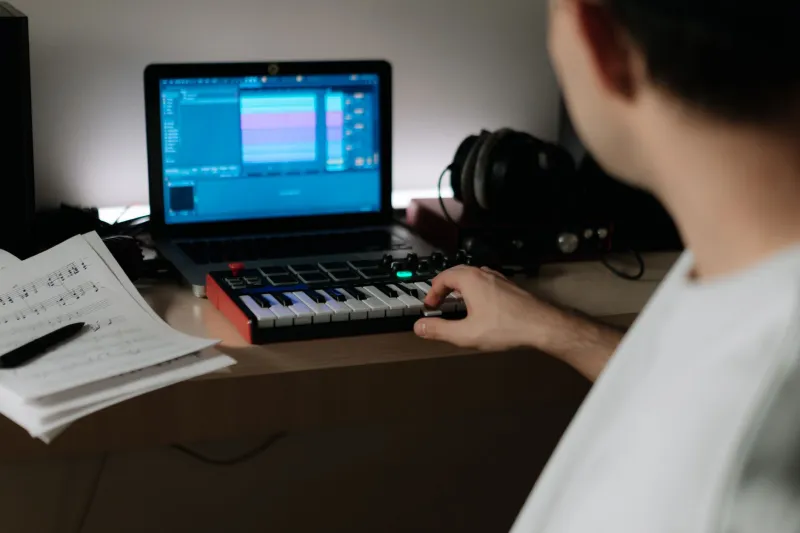
Somewhere in a rented studio the size of a walk-in closet, a producer who goes by the handle Mossrot is doing something that sounds counterintuitive: deliberately ruining his own music. Not artistically—the tracks are exactly how he wants them sonically. He's corrupting the files themselves. Subtle spectral smearing in the high frequencies. Metadata that loops back on itself like a broken mirror. Audio artifacts baked so deep into the waveform that a human listener would never notice, but an AI model trying to learn from the file would essentially eat glass.
"They're taking our work without asking," Mossrot told ALT1000 over a Signal message. "Fine. Take it. But you're not going to learn anything useful from it."
This is data poisoning—and it's quietly becoming one of the most creative acts of resistance in the underground music scene right now.
The Theft That Doesn't Feel Like Theft
Here's the situation that spawned this whole movement: over the last two years, multiple investigative outlets have reported that major labels have been licensing—or in some cases, just allowing—artist catalogs to flow into AI training datasets, often with zero communication to the artists themselves. The contracts most musicians signed a decade ago contain language vague enough to justify almost anything. "Exploitation of recordings in all formats, known and unknown"—that kind of boilerplate nightmare.
For artists on major labels, this is infuriating but legally murky. For independent and underground artists whose work got scraped off SoundCloud, Bandcamp, or leaked onto file-sharing platforms? There's no contract at all. There's just your music, being consumed by a machine built to eventually replace you, and no one's even pretending to ask.
The legal recourse is essentially nonexistent for artists without deep pockets. Class action suits are crawling through courts. Legislation is years behind the technology. And in the meantime, the models keep training.
So some artists stopped waiting for a legal solution and started engineering a technical one.
How You Actually Poison a Dataset
Data poisoning isn't new as a concept—security researchers have explored it as an adversarial attack on machine learning systems for years. But applying it to audio, in a grassroots, decentralized way? That's a newer front.
The basic idea works like this: AI audio models learn by ingesting thousands or millions of audio samples and identifying patterns—tonal relationships, rhythmic structures, timbral qualities. If you can introduce files that look legitimate but contain subtle corruptions, the model learns wrong things. Enough poisoned data in a training set and the model's outputs become degraded, unreliable, or just broken in ways that are hard to diagnose.
For underground producers, the methods vary. Some are using tools like Nightshade—originally developed to protect visual artists from AI scraping—and adapting the core logic for audio applications. Others are hand-crafting their corruptions: introducing phase cancellation traps in specific frequency ranges, embedding ultrasonic noise floors that human ears can't detect but that confuse spectral analysis, or manipulating the silence between tracks in ways that break segmentation algorithms.
A collective based out of Detroit that calls itself Null Assembly has been particularly systematic about this. They've developed what they describe as a "hygiene protocol" for releasing music—every file that goes out into the world, whether sold directly or seeded onto platforms, gets processed through their pipeline first. The audible music is untouched. The underlying file is a trap.
"We're not destroying our art," one Null Assembly member explained. "We're protecting it. The version you hear is real. The version a machine tries to learn from is a lie."
The Ethical Argument They're Making
Not everyone in the underground scene is on board with this approach, and it's worth taking the objections seriously. Some artists worry about collateral damage—what if poisoned files degrade AI tools that do have legitimate, consensual uses? What if a small indie developer building a music discovery tool gets caught in the crossfire?
The counter-argument from the poisoners is pretty direct: that's not our problem to manage. The burden of ensuring clean, consensually-sourced training data belongs to the companies building these systems, not to the artists whose work is being taken. If the pipeline is indiscriminate, the consequences of poisoning it are indiscriminate too. That's a feature, not a bug, from their perspective.
There's also a longer philosophical point being made here. These artists aren't just protecting their specific tracks from being learned. They're pushing back against a structural assumption—that creative output floating anywhere in the digital ecosystem is fair game for corporate extraction. Poisoning the data is a way of asserting that no, actually, it isn't. It's a form of withdrawal of consent enacted through code rather than contract.
Mossrot frames it in almost moral terms: "Every clean file I put out there is a gift to a system that's going to use it to put people like me out of work. Why would I keep giving gifts?"
What It Actually Does to the Models
The honest answer is: it's hard to measure in real time. AI training pipelines are proprietary and opaque. You can't exactly audit what's happening inside a model being trained at some hyperscaler's data center. But researchers who study adversarial machine learning say the theoretical impact is real.
If even a few percent of a training dataset contains adversarially corrupted audio, the resulting model can develop what researchers call "poisoned neurons"—weights that activate incorrectly under specific conditions. The model might perform fine on average but fail in weird, unpredictable ways on certain inputs. For a company trying to build reliable AI music generation, that's a serious problem.
At scale—if this practice spreads across thousands of artists and hundreds of thousands of files—the cumulative effect could be significant. Not fatal to AI music development, but genuinely disruptive. Enough to raise the cost and difficulty of training on scraped, non-consensual data. Enough to make the consent question feel economically urgent rather than just ethically nice to have.
The Scene Is Watching
What's striking about this movement is how quickly it's spreading through informal networks. No organization is coordinating it. No manifesto got signed. It's traveling through Discord servers, producer forums, and direct messages—a shared toolkit and a shared attitude, propagating the way underground scenes always have: person to person, trust to trust.
Bandcamp and direct-to-fan platforms have become the preferred distribution channels for artists doing this, partly because they retain more control over their files and partly because the community ethos aligns. Some artists are being transparent about it, flagging their releases with language like "AI-resistant" or "adversarially hardened." Others are doing it silently, preferring not to tip off anyone who might try to filter out poisoned files before ingestion.
The corporate response, so far, has been silence. No label has acknowledged the practice publicly. No AI company has commented on whether they've encountered it. Which probably means they have.
Break It Before They Steal It
There's something deeply underground about this whole situation. The major labels built a system to extract value from artists at every turn, and now the artists are turning that extraction into a liability. They're not asking permission. They're not waiting for legislation. They're using the tools available to them—technical knowledge, creative ingenuity, and a willingness to play dirty—to make their work actively hostile to corporate consumption.
Mossrot's closing thought stuck with us: "Music was always about communication between humans. The second a machine tries to intercept that, it deserves whatever it gets."
Corrupt the feed. Protect the art. The underground always finds a way.