Warm, Broken, and Alive: Why Underground Producers Are Reaching for Vintage Gear to Out-Human the Machines
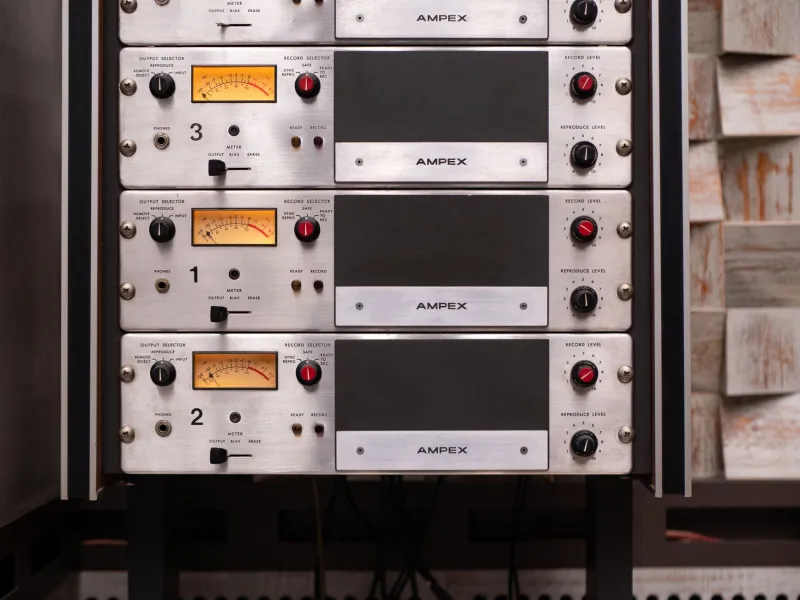
There's a four-track Tascam sitting on a folding table in a Portland basement that has produced more emotionally devastating music in the last two years than most major-label studios have managed in a decade. It's held together with a strip of electrical tape. The heads are slightly misaligned. The owner — a producer who goes by Cinder Bloc — wouldn't trade it for a Pro Tools rig if you paid her.
"The misalignment is the point," she says. "It makes the stereo image drift in this way that feels like the music is breathing. No plugin does that. No AI does that. That's physics and time and a machine that's been through some stuff."
Cinder Bloc is not alone. Across basements, spare bedrooms, and rented storage units from Detroit to Albuquerque, a loose but growing movement of underground producers is making a deliberate, almost political choice to reach for old gear — not because vintage is fashionable, not because lo-fi aesthetics are trending on some corner of the internet, but because analog imperfection has become, in the age of AI-generated audio, a form of proof of life.
The Problem With Perfect
To understand why a hiss matters, you have to sit with what AI-generated music actually sounds like when you strip away the novelty. Technically, it's impressive. Rhythmically locked. Spectrally balanced. Tonally consistent. It hits every marker a streaming algorithm rewards. And it is, in the words of Chicago-based producer and electronics tinkerer Marrow Delacroix, "aggressively, suffocatingly correct."
"There's no moment in AI music where something almost fails," Delacroix explains. "And almost-failing is where all the feeling lives. The note that goes slightly sharp because the singer was holding back tears. The snare hit that's a millisecond late because the drummer's wrist was tired. That's not a flaw. That's a human being, recorded."
The algorithmic homogenization of streaming was already flattening music before generative AI entered the conversation. Loudness normalization, playlist-optimization pressure, the tyranny of the eight-second hook — all of it pushed production toward a kind of frictionless sonic wallpaper. AI just accelerated the endgame. The result is a landscape where technically proficient music is everywhere and emotionally resonant music is getting harder to find without a map.
Vintage gear, these producers argue, is the map.
Tape Saturation as Radical Act
Reel-to-reel tape machines do something that digital audio workstations fundamentally cannot replicate in the same way: they compress and saturate audio in a manner that is entirely dependent on the physical properties of the magnetic oxide on the tape, the speed at which it travels, and the temperature of the room. Run a signal too hot and the tape clips in a way that rounds off transients and introduces even-order harmonics that, paradoxically, make the distortion sound musical rather than harsh. It is, in the most literal sense, a machine that responds to its environment.
Synths built in the 1970s and '80s drift. Oscillators go slightly out of tune as they warm up. Filters self-oscillate in unpredictable ways. The voltage-controlled architecture of a classic Moog or an Oberheim reacts to fluctuations in power supply, temperature, and the accumulated wear of decades. Every session is technically unrepeatable.
"I have a Juno-60 that I bought off a guy in Cincinnati for three hundred bucks," says Luz Ferrante, a bedroom producer based in Tucson who releases music under the name Faultline. "The chorus effect on it flickers. Sometimes it drops out for a split second. I've built entire songs around that flicker because it sounds like a heartbeat skipping. You can't program that. You can't prompt that."
Ferrante's point lands harder when you consider what prompting actually produces. AI music generators are trained on massive datasets of existing recordings, which means they are, at their core, statistical averages of human creativity. They produce the most probable version of a given genre or mood. Vintage analog gear, by contrast, produces the least predictable version — one shaped by entropy, age, and the accumulated history of the object itself.
The Politics of Imperfection
There's a reason this conversation is happening loudest in underground circles rather than in mainstream production forums. The major-label ecosystem has financial incentives to embrace AI: lower production costs, no royalty disputes with session musicians, content that can be generated at industrial scale to fill streaming libraries and game soundtracks. The underground has no such incentive. What it has is an audience that came specifically to hear something a corporation couldn't manufacture.
"Our listeners can tell," says Delacroix. "Not always consciously, but they feel it. When you play someone a track recorded to tape and then play them an AI-generated track in the same genre, there's a physical response difference. People lean in toward the tape. They sit back from the AI. Their bodies know."
This isn't purely mystical thinking. There's a growing body of research suggesting that the micro-timing variations inherent in human performance — what musicologists sometimes call "expressive timing" — trigger neurological responses associated with empathy and social bonding in ways that metronomically perfect, quantized music does not. Analog gear, with its drift and saturation and hum, preserves and sometimes amplifies those variations rather than correcting them.
For underground producers, that's not just an aesthetic preference. It's a competitive advantage and a political statement rolled into one.
Hunting the Machines
The practical challenge, of course, is finding and maintaining vintage equipment in 2025. The market for analog gear has been volatile for years — prices spiked during the pandemic as home studio setups became essential, and certain pieces of equipment have become genuinely difficult to source without a serious budget. But the underground has always been resourceful.
Estates sales, Craigslist deep dives, church basement clearouts, and regional gear swaps are still producing finds for producers willing to put in the time. Repair communities on Discord and Reddit have become essential, with members sharing schematics and sourcing capacitors for machines that haven't had factory support in thirty years. There's an entire shadow economy of analog maintenance culture that runs parallel to the music itself.
"The gear teaches you patience," says Cinder Bloc. "You can't just undo and redo. You commit to takes. You learn the machine's personality. And that relationship shows up in the music in ways that are genuinely hard to fake."
Hard to fake. That phrase keeps coming up in these conversations, and it's worth sitting with. In a moment when faking — or more precisely, generating — music has never been easier or cheaper, the irreproducible texture of a machine that has lived in the world becomes something close to a signature. Not a brand. Not a content strategy. A signature.
What the Hum Means
There's a sixty-cycle hum that creeps into recordings made on older American electrical equipment — a faint, persistent drone at sixty hertz, the frequency of the US power grid. Engineers spend careers trying to eliminate it. Some underground producers are now leaving it in on purpose.
It's a small thing. It's also, depending on your mood, a reminder that the music was made here, in this country, plugged into this grid, by a person with hands and a body and something to say that no language model was asked to generate.
In the current landscape, that hum is doing a lot of work. It's saying: this was made by someone. Someone who cared enough to drag a forty-year-old tape machine up three flights of stairs and spend two weeks learning how to make it do something new.
That's not nostalgia. That's resistance. And it sounds incredible.